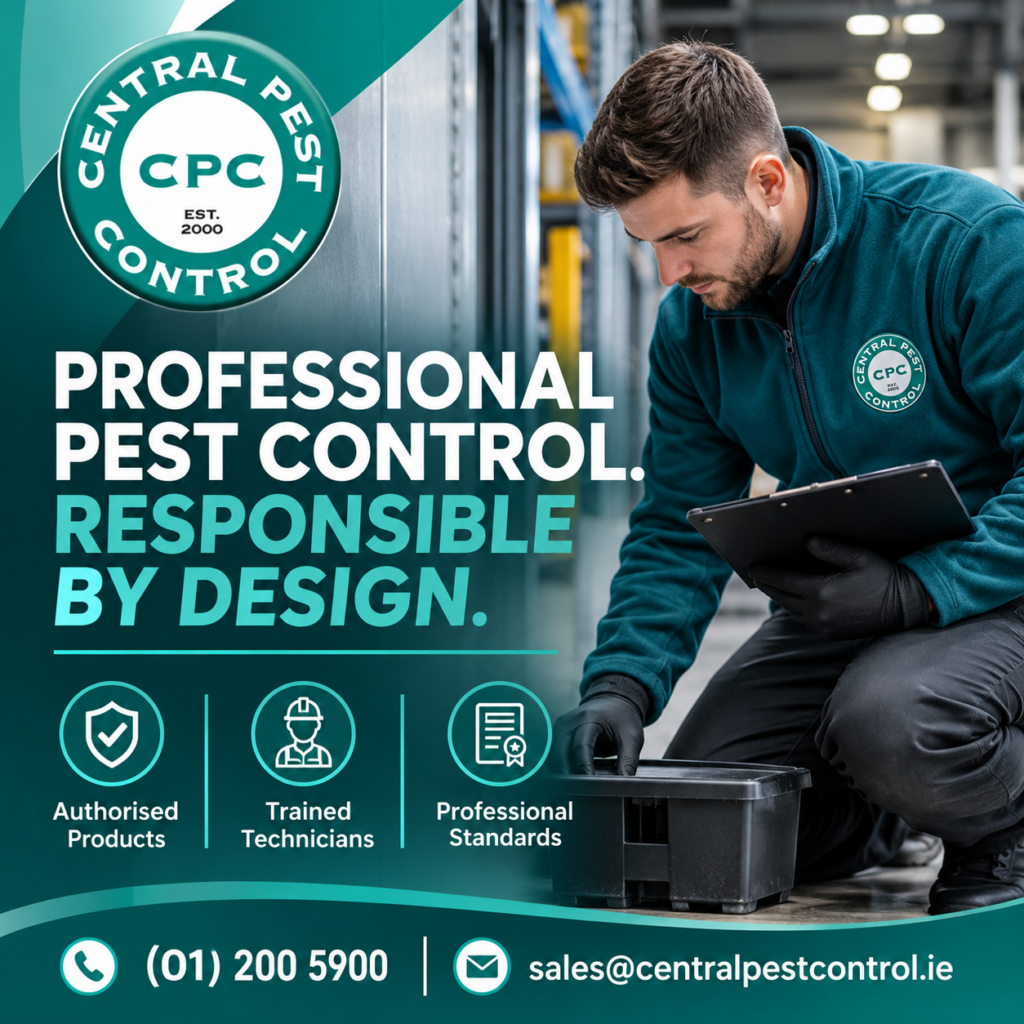
When it comes to pest control, the products used and the people applying them matter.
Professional pest management involves much more than simply treating an infestation. It requires an understanding of pest behaviour, appropriate product selection, technical training, risk assessment and responsible application.
Whether dealing with rodents in a commercial premises, insects in a food business or a persistent infestation in a residential property, pest control treatments must be carried out correctly and with consideration for people, animals and the surrounding environment.
At Central Pest Control, we believe that professional standards should be at the centre of every pest management service.
We use authorised biocidal products and rodenticides, with trained Pest Management Trained Professional User (PMU) technicians, following the relevant product authorisations, safety requirements and professional guidelines.
But what does this actually mean, and why should customers care about the qualifications and products used by their pest control provider?
What Are Biocides and Why Must They Be Authorised?
Biocidal products are substances or mixtures used to control harmful or unwanted organisms.
In the pest control industry, these can include:
- Insecticides used to control crawling and flying insects.
- Rodenticides used to control rats and mice.
- Disinfectants used to control harmful microorganisms.
- Other specialist products used in professional pest management.
These products are designed to control specific target organisms, but their use must also take account of potential risks to people, animals and the environment.
In Ireland, biocidal products are regulated under the European Biocidal Products Regulation (EU) No. 528/2012.
Products must be authorised or notified by the appropriate competent authority before they can be legally distributed and used in Ireland, as applicable to their regulatory status.
The Department of Agriculture, Food and the Marine (DAFM) oversees the regulation of biocidal products in Ireland.
This means professional pest controllers cannot simply select any chemical product and use it however they wish.
The product must be appropriate for the intended purpose and used in accordance with its authorisation and label instructions.
What Is a PMU Registered Pest Control Technician?
PMU stands for Pest Management Trained Professional User.
In Ireland, individuals using products authorised for trained professional use must meet the relevant training and registration requirements.
PMU registration is particularly important in the professional rodent-control industry, where certain rodenticides are restricted to appropriately trained users.
A PMU is an individual trained professional user registered with the Department of Agriculture, Food and the Marine.
The registration demonstrates that the individual has met the relevant professional competence requirements.
It is important to understand that a PMU number belongs to the individual technician, not the pest control company.
At Central Pest Control, our trained PMU service technicians work in accordance with the applicable requirements for professional pest management and the products they use.
This is particularly important when carrying out commercial rodent-control work, where product selection, placement, monitoring and record keeping all form part of responsible pest management.
Why Does Professional Training Matter?
Pest control products can be effective when used correctly, but inappropriate application can create unnecessary risks.
Professional training helps technicians understand:
- How different pest species behave.
- Which treatment methods are appropriate.
- How to assess an infestation before treatment.
- How to identify potential risks to people and non-target animals.
- How to select suitable authorised products.
- Correct application methods and product restrictions.
- Safe placement of rodenticide bait stations.
- Monitoring, inspection and record keeping.
- The importance of preventative pest management.
A trained technician understands that treating an infestation is not simply about applying a product.
The objective is to achieve effective pest control while managing potential risks and following the relevant regulatory requirements.
Responsible Rodenticide Use: More Than Just Putting Down Bait
Rodent control is one of the areas where professional knowledge and responsible product use are particularly important.
Rats and mice can create serious problems for homes and businesses, including damage to property, food contamination and potential health concerns.
However, rodenticides must be used responsibly.
Certain anticoagulant rodenticides can pose risks to non-target animals, including pets and wildlife such as birds of prey, particularly where poisoned rodents are consumed by other animals.
This is why professional rodent control should follow an Integrated Pest Management (IPM) approach.
Rather than automatically relying on rodenticide, technicians should consider the wider conditions contributing to the infestation.
This can include:
Inspection and Identification
Identifying rodent activity, entry points, harbourage areas and potential food sources.
Proofing and Prevention
Identifying gaps, access points and building defects that may allow rodents to enter a property.
Monitoring
Using appropriate monitoring methods to establish the level of activity and assess whether control measures are working.
Responsible Baiting
Where rodenticide is necessary, selecting an appropriate authorised product and using it in accordance with its label, risk assessment and applicable restrictions.
Follow-Up and Records
Monitoring treatment progress, reviewing activity and maintaining appropriate treatment records.
This approach helps ensure that rodent control is targeted, proportionate and professionally managed.
Why Integrated Pest Management Is Important
Integrated Pest Management is an approach that combines different methods to prevent and control pest activity.
It recognises that effective pest control is not always achieved through chemical treatment alone.
Depending on the property and infestation, an IPM programme may include:
- Regular inspections.
- Identifying pest entry points.
- Environmental improvements.
- Waste management.
- Building proofing.
- Monitoring stations.
- Trapping.
- Appropriate professional treatments.
- Ongoing reviews and reporting.
For commercial businesses, this is particularly important.
Restaurants, hotels, warehouses, offices and food-production facilities need pest management strategies that address the underlying causes of pest activity rather than simply reacting when a problem occurs.
A structured approach also helps businesses demonstrate that pest risks are being monitored and managed appropriately.
Why Commercial Businesses Should Check Their Pest Control Provider
When appointing a pest control company, businesses should look beyond the price of an individual treatment.
The products used, the training of technicians and the procedures followed can all make a difference to the quality of the service.
Commercial customers should consider asking:
- Are the products being used authorised for their intended purpose in Ireland?
- Are the technicians appropriately trained and registered where required?
- Does the company carry out site assessments and risk assessments?
- Are rodenticides being used in accordance with their product labels?
- Are baiting locations and treatment activities recorded?
- Is there a monitoring and follow-up process?
- Does the company provide practical advice on preventing future infestations?
For businesses operating in food, hospitality, healthcare and other hygiene-sensitive environments, choosing a professional pest management provider is an important part of responsible premises management.
How Central Pest Control Approaches Professional Pest Management
Central Pest Control is a fully Irish-owned, family-run pest control company with over 35 years of industry experience.
We provide domestic and commercial pest management services across Dublin, Wicklow and Kildare.
Our approach is based on professional inspections, appropriate treatment methods and preventative pest management.
We understand that every property and infestation is different. Our technicians assess the situation and determine the appropriate course of action based on the pest involved, the environment and the customer’s requirements.
Our professional standards include:
Authorised Products
Using appropriate authorised biocidal products and rodenticides in accordance with their relevant conditions of use.
Trained PMU Technicians
Our trained PMU service technicians understand the importance of professional competence and responsible rodenticide use.
Risk Assessments
Considering the property, the infestation, potential exposure and relevant safety requirements before treatment.
Responsible Application
Following product label instructions, application requirements and appropriate safety procedures.
Monitoring and Prevention
Looking beyond the immediate infestation to identify conditions that may contribute to recurring pest activity.
Professional Service
Providing customers with practical advice and a pest management approach suited to their property and requirements.
We believe customers should have confidence in knowing that their pest control provider understands the responsibility involved in professional pest management.
Pest Control Is About More Than Getting Rid of Pests
Rats, mice, insects and other pests can cause significant problems for homes and businesses.
However, how an infestation is treated matters just as much as the result.
Professional pest control requires appropriate products, trained technicians, responsible application and a clear understanding of the risks involved.
At Central Pest Control, we take these responsibilities seriously.
Whether you require commercial rodent control, insect treatments or an ongoing pest management programme, our team can help identify the problem and recommend an appropriate solution.
Looking for a professional pest control company in Dublin, Wicklow or Kildare?
Contact Central Pest Control today.
Central Pest Control Ltd
Telephone: (01) 200 5900
Email: sales@centralpestcontrol.ie
Website: https://centralpestcontrol.ie/
Professional pest management. Responsible treatment. Experienced technicians.
Frequently Asked Questions
1. What is a PMU registered pest controller?
A PMU is a Pest Management Trained Professional User registered with the Department of Agriculture, Food and the Marine. PMU registration demonstrates that an individual has met the relevant training and competence requirements for the use of specified trained professional pest-control products.
2. Are pest control products regulated in Ireland?
Yes. Biocidal products are regulated under the European Biocidal Products Regulation. Products must have the appropriate authorisation or notification status before they can be legally marketed and used in Ireland.
3. Can anyone buy and use professional rodenticides?
No. Certain rodenticides are restricted to trained professional users who meet the applicable requirements. Other products have different user categories and restrictions. The product authorisation and label determine who may use them and under what conditions.
4. Why is it important to use authorised biocidal products?
Authorisation ensures that products have undergone the relevant regulatory assessment and that their permitted uses and conditions are defined. Using products outside their authorised conditions can create unnecessary risks to people, animals and the environment.
5. Are rodenticides dangerous to pets and wildlife?
Some rodenticides can pose risks to non-target animals, particularly if bait or poisoned rodents are accessed or consumed. Professional pest controllers must consider these risks and follow appropriate product instructions, risk assessments and responsible rodenticide-use guidance.
6. What is Integrated Pest Management?
Integrated Pest Management (IPM) is an approach that combines inspection, monitoring, proofing, environmental management and appropriate treatment methods to prevent and control pest activity. It aims to achieve effective pest management while reducing unnecessary reliance on chemical products.
7. Does Central Pest Control use trained PMU technicians?
Central Pest Control uses trained PMU service technicians for the relevant professional pest management work, supporting responsible rodenticide use and compliance with applicable requirements.
8. How can I check whether a pest control company is professionally registered?
Customers can consult the Department of Agriculture, Food and the Marine’s register of Pest Management Trained Professional Users. They can also ask their pest control provider about technician training, PMU registration and the products used during treatments.
For more information, visit the official DAFM website.